When you apply for a loan or credit facility, banks evaluate a lot more than your income. Banks also look at how responsible you are with credit by looking at how you have borrowed and repaid credit in the past.
In Nepal, the word ‘credit score’ may be unfamiliar, but most people would have heard terms like CIB report, CIB record, or the CIB blacklist. Knowing these concepts will help borrowers make informed decisions and help them keep a better credit record.
What Is a Credit Score?
A credit score is the measure of an individual’s ability to pay back loans or credit under a financial contract. Lenders determine how trustworthy an individual may be depending on someone’s credit score.
You may have heard of credit scores ranging from 300 to 850 in countries such as the United States. Nepal does not simply follow this same consumer scoring model.
Banks and financial institutions in Nepal assess borrowers using several factors, including:
- Previous repayment behavior
- Existing loans and liabilities
- Regular income
- Ability to repay
- Credit history
- Information available through CIB Nepal
For Nepali borrowers, maintaining a healthy credit history is therefore more important than focusing only on a particular score.
Does Nepal actually have a credit score?
Yes. Karja Suchana Kendra Limited, the organization most people call CIB Nepal, produces a credit score for individual borrowers.
The scale runs from 60 to 960. The closer your number sits to 960, the lower your statistical probability of default, and the more comfortable a lender is likely to feel. The score is calculated from roughly the last 15 months of your credit behavior, which is worth pausing on. Something that went wrong four years ago carries less weight in the score than an EMI you paid ten days late this Ashad.
One important detail: this score is supplied to banks and financial institutions as part of a credit report, not published to the public the way a FICO score is in the United States. There is no app where you log in and watch your number move. Your record exists; it is shared across the industry, and you experience it indirectly, through the answer you get when you apply.
That is also why the practical advice for Nepali borrowers is slightly different from the foreign content you may have read. Chasing a number you cannot see is pointless. Protecting the behavior that produces the number is not.
What is CIB Nepal?
CIB Nepal, formerly Karja Suchana Kendra Limited, is Nepal’s credit information bureau. It was set up in May 1989, one of the oldest such bureaus in the SAARC region, to slow the growth of bad loans in the banking system. It registered as a company in 2004 and has operated as an independent entity since March 2005, under the provisions of the Nepal Rastra Bank Act, 2058.
Ownership tells you a lot about how it works. Banks and financial institutions hold 90 percent of its equity; Nepal Rastra Bank holds the remaining 10 percent. Every NRB-licensed institution that lends money is required to be a member.
The Bureau itself does not approve or reject anything. It collects credit data from member institutions, cleans and consolidates it, and hands it back as a report when a lender asks. The lending decision stays entirely with the bank.
What your CIB report shows
Your report is a factual record, not an opinion. Typically it covers:
- The credit facilities you hold or have held, and with whom
- Sanctioned and outstanding amounts
- Whether you are the main borrower, a joint borrower, or a guarantor
- Repayment history, including how many days late each payment was
- Overdue amounts and any blacklist status
That third point catches people out. If you stood as a guarantor for a cousin’s business loan, that liability appears against your name too. When the cousin stops paying, you feel it on your own next application.
How banks use it
A lender builds a picture from several inputs, and credit history is one of them. When you apply for a home loan or an auto loan at Global IME Bank, the assessment also looks at your income, how much of that income is already going out as EMI, the quality of your documentation, the security offered, and the bank’s own lending policy.
So a clean CIB record does not guarantee approval on its own. What it does is remove a reason to say no.
It can also change the shape of an approval rather than the answer. A borrower with patchy repayment history might still get sanctioned, just for a smaller amount, or with a tighter tenure, or with an extra condition attached. Many people never learn that their record cost them anything, because the loan did come through, only smaller than they expected.
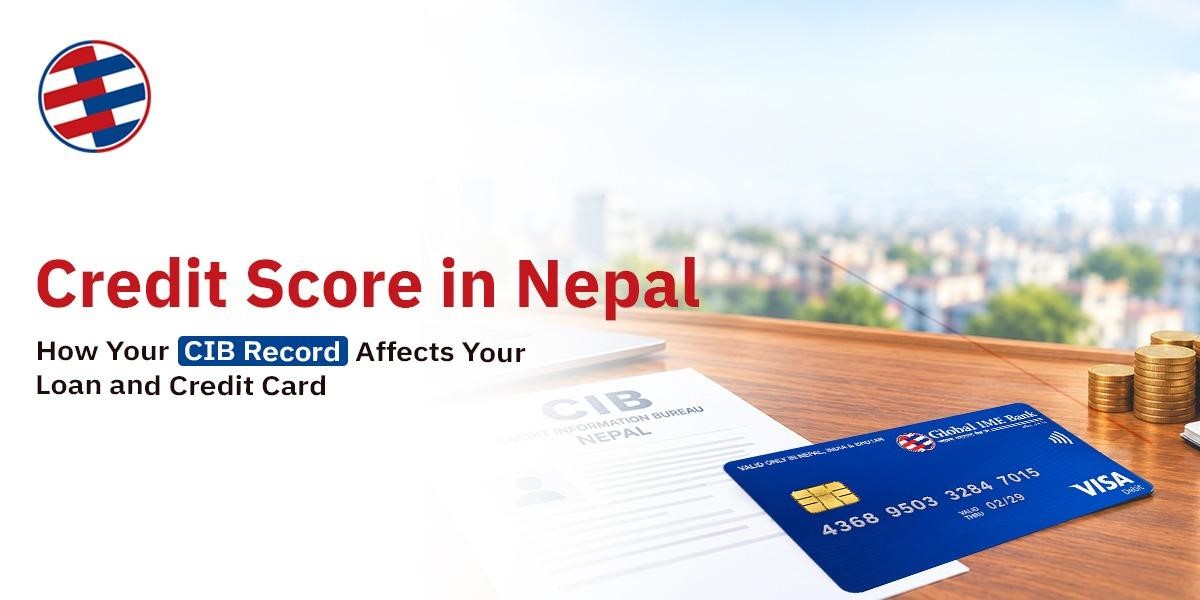
The same logic applies to cards. Before issuing a Visa Domestic Classic Credit Card, the bank reviews income, existing obligations, repayment capacity, and credit information. If you want the full picture of documents and eligibility, we have covered that separately in how to get a credit card in Nepal.
Having a CIB record is not the same as being blacklisted
This confusion causes real anxiety, so let’s separate the two clearly.
Everyone who has ever borrowed has a CIB record. A car loan repaid perfectly over five years sits in your record. That is a good thing. It is evidence.
Blacklisting is a specific, serious status. Under NRB directives, the grounds include principal and interest remaining overdue with an outstanding balance, misuse of a credit facility, the bank issuing an auction notice to recover the loan, a court conviction in a forgery or criminal matter, failure to repay after a court order in the bank’s favor, and dishonored cheques. NRB tightened the cheque-bounce provisions in 2082, so that route to blacklisting is stricter than it was a few years ago.
The Bureau cannot add or remove anyone by itself. A name goes on the list only on the written recommendation of a bank or financial institution, and comes off the same way, usually after the dues are cleared, or the facility is rescheduled or restructured under NRB’s prudential norms, or another party acceptable to the bank’s board accepts the liability.
If you think you are listed and shouldn’t be, start with the bank that reported you. That is where both the listing and the delisting originate.
Can you check your own credit information?
Partly, and the rules here are genuinely strict.
An individual cannot simply buy their own credit report from Karja Suchana Kendra. Only member institutions can pull reports. You can, however, obtain a copy through your lending institution, which requests it from the Bureau on your behalf. Blacklist status is treated slightly differently: an individual may receive that information on a written request to KSKL.
The practical route, then, is your bank. If a loan application has been affected by information you believe is inaccurate, raise it with the branch first and ask them to check the reported data with the institution that submitted it.
Six habits to Build a Healthy Credit Record in Nepal
No. You do not need complicated financial strategies to maintain a healthy credit history. A few consistent habits can make a significant difference.
1. Treat the EMI date as fixed. Payment timing is the single heaviest factor in your history, and small delays repeated across months read worse than one unavoidable slip. Standing instructions on your salary account remove the memory problem entirely.
2. Pay more than the minimum on your card. Paying only the minimum is permitted and keeps your record clean, but the revolving balance grows. Use the interest-free period properly and clear the full statement amount when you can.
3. Know your real EMI-to-income ratio. Add up every monthly obligation you already carry before adding another. Our loan eligibility calculator will show you where you stand in about a minute.
4. Don’t apply everywhere at once. Several applications across several institutions in a short window is a pattern lenders notice, and it rarely reads as strength.
5. Take guarantees seriously. Guaranteeing a loan is a real liability on your record, not a paper favour. Only do it for someone whose repayment you would be willing to make yourself.
6. Talk to the bank before you miss a payment, not after. Restructuring a repayment while the account is still regular is an ordinary banking conversation. Doing it after a long default is a much harder one.
Credit score and credit rating are not the same thing
A credit score measures how an individual handles borrowed money.
A credit rating is an opinion on a company, institution, or financial instrument, issued by specialized rating agencies such as ICRA Nepal, and expressed in symbols rather than numbers.
If you are applying for a personal loan or a credit card, the score side is what concerns you. Ratings belong to debenture issues and corporate borrowers.
Start where you are
If you have never borrowed, you have no history, which is not the same as bad history. Good credit in Nepal isn’t about borrowing more. It is about the bank being able to look at fifteen months of your behavior and find nothing that gives it pause.
Explore Global IME Bank’s personal banking products or visit your nearest branch to discuss what fits your situation. All credit facilities are subject to the bank’s eligibility criteria and approval.
Frequently Asked Questions
Does Nepal have a credit score system?
Yes. Karja Suchana Kendra Limited produces a credit score on a 60 to 960 scale, based on about 15 months of credit history. It is supplied to lenders inside a credit report rather than published to consumers, so Nepal does not use the 300 to 850 model common in foreign financial content.
What is the full form of CIB in Nepal?
CIB stands for Credit Information Bureau. The institution is formally registered as Karja Suchana Kendra Limited.
What does CIB Nepal do?
It collects credit information from member banks and financial institutions, consolidates it, and issues credit reports and scores back to those members for use in their lending decisions. It does not approve or reject loans.
Can I get my own CIB report?
Not directly from the Bureau. Reports are issued to member institutions, but you can obtain a copy through your lending bank, which requests it on your behalf. Blacklist status can be sought from KSKL in writing.
Does being in CIB records mean I am blacklisted?
No. Every borrower has a record. Blacklisting is a separate status applied on a bank’s written recommendation, for defined reasons such as prolonged default, misuse of a facility, or dishonored cheques.
How long does negative information stay on my record?
The score reflects roughly the last 15 months, so recent behavior carries the most weight. Blacklist status is different: it remains until the underlying obligation is settled and the reporting bank recommends removal.
Is a good CIB record enough to get a loan approved?
No. Banks also assess income, existing obligations, repayment capacity, documentation, security, and their own lending policy.