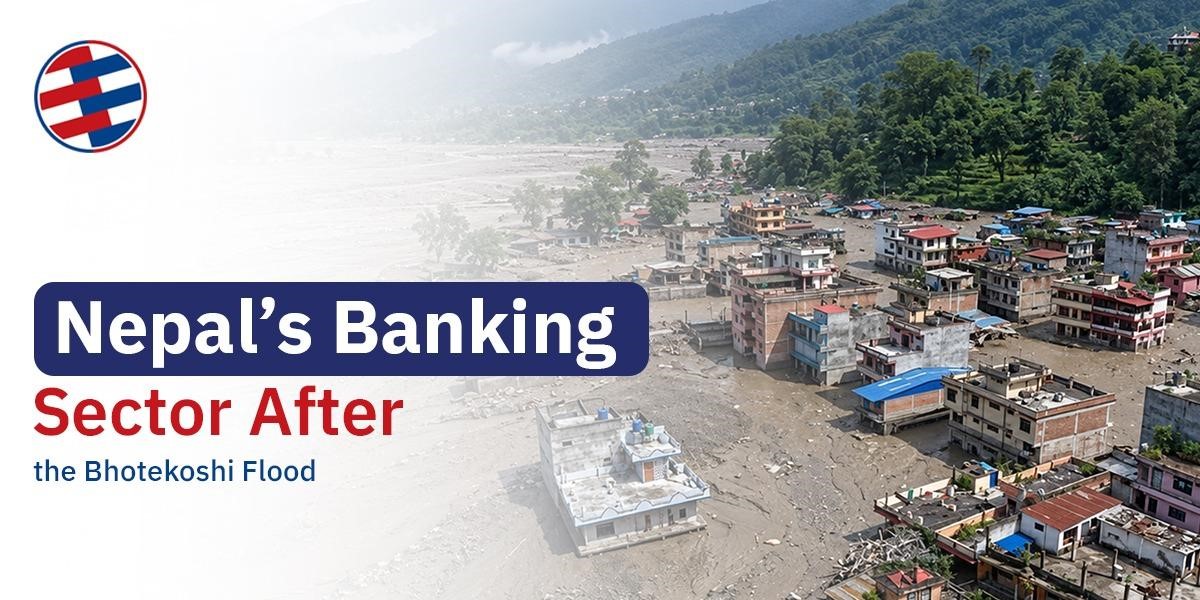
At 8:40 in the morning on Bhadra 10, 2083 (August 26, 2026), an ice and rock avalanche roughly 20 kilometers north of the Rasuwagadhi checkpoint blocked the Lhende Khola on the Tibetan side of the border. The natural dam it formed did not hold. When it burst, it sent water, boulders and debris down the Bhotekoshi into the Trishuli, and the surge covered roughly 80 kilometers from Rasuwagadhi to Devighat in about 25 minutes.
What the flood did to bank branches
Estimates moved as assessments deepened. Rather than pick one, here is how the reported numbers evolved, which is itself part of the story.
| Assessment | Date | Branches affected | Banks | Physical loss (excluding cash) |
| Nepal Bankers’ Association, first count | Aug 26 | 9 branches swept away | 9 commercial banks | Not yet assessed |
| NBA preliminary | Aug 30 | 16 branches (15 destroyed, 1 heavily damaged) | 11–12 banks | ~Rs 551 million |
| NBA revised | Early Sept | 16 branches | 12 banks | ~Rs 600 million |
| RDNA (NPC + NDRRMA) | Sept 12 | 17 branches | 12 commercial banks | Rs 720.4 – 724 million |
The Rapid Damage and Needs Assessment prepared jointly by the National Planning Commission and the NDRRMA is the authoritative figure. Its bank-by-bank breakdown:
| Bank | Branches affected | Reported loss (Rs) |
| Agricultural Development Bank | 1 | 650,000,000 |
| Citizens Bank | 1 | 15,600,000 |
| Laxmi Sunrise Bank | 1 | 11,200,000 |
| NIC Asia Bank | 3 | 8,800,000 |
| Himalayan Bank | 1 | 7,500,000 |
| Machhapuchchhre Bank | 1 | 7,500,000 |
| Nabil Bank | 1 | 6,300,000 |
| Sanima Bank | 1 | 6,300,000 |
| Prabhu Bank | 2 | 5,300,000 |
| Nepal Investment Mega Bank | 3 | 4,000,000 |
| Global IME Bank | 1 | 1,100,000 |
| NMB Bank | 1 | 400,000 |
| Total | 17 | ≈ 723,900,000 |
The affected branches were operating in Bidur Municipality of Nuwakot and in Gosaikunda, Kalika and Uttargaya rural municipalities of Rasuwa. One institution accounts for nearly 90 percent of the total: Agricultural Development Bank’s Trishuli branch, which operated from its own building and was levelled, taking 64 safety deposit lockers with it.
The money that was physically in the buildings
The Nepal Bankers’ Association counted cash separately, because it was insured and therefore excluded from the physical-damage estimate.
| Item | Amount / count |
| Cash in vaults | Rs 172.4 million |
| Cash at counters | Rs 11.7 million |
| Cash in ATMs (nine machines) | Rs 11.663 million |
| ATM counters in affected areas | 8 |
| Depositors attached to affected branches | 78,204 |
An earlier NBA count put deposits at the destroyed branches at Rs 3.98 billion across 73,275 accounts, with Rs 2.33 billion in outstanding loans across 2,028 borrowers. A separate figure cited in economic reporting put non-hydropower loan exposure in the flood zone at Rs 2.43 billion. These counts were taken on different dates and with different branch definitions, and no reconciled figure has been published.
What Global IME Bank did?
| Action | Detail |
| Contribution to PM Disaster Relief Fund | Rs 50 million, under CSR, for search and rescue, treatment of the injured, food and shelter for the displaced, and long-term infrastructure reconstruction |
| Position among commercial bank donors | Largest single commercial-bank cash contribution reported to the fund |
| Parent group contribution | IME Group pledged NPR 100 million to the PMDRF, channelled through Global IME Bank, IME Limited, IME Life Insurance, IGI Prudential, Chandragiri Hills, DishHome, IME Motors, Ashok Leyland, IME Khalti, Swift Technology, Midas Health, MyMart, Lumbini Cable Car, IME Foundation and other group companies |
| Employee contribution | One day’s salary from staff across IME Group companies |
| In-app donation channel | Direct contribution to the PMDRF through the Global Smart Plus mobile banking app: select the designated account, enter contributor name and amount |
| Official PMDRF collection bank | Accounts 00401010000057 and 00411010000005, SWIFT GLBBNPKA |
| Group microfinance arm | Global IME Laghubitta Bittiya Sanstha and its employees contributed Rs 1,635,555 to the PMDRF |
| Free remittance for relief donations | IME made remittance free for sending donations to Nepal from abroad; donations also routed free through the Khalti by IME wallet |
The implication for the national economy
The RDNA released on September 10 puts the reconstruction and recovery requirement at Rs 723.31 billion.
| Sector | Recovery requirement | What was damaged |
| Infrastructure (≈75% of total) | Rs 473.57 billion | — |
| Energy and power grid | Rs 390.62 billion | 13 hydropower projects (759 MW); 5 solar plants (24 MW) |
| Transport | Rs 73.34 billion | 69 km of roads; 33 motorable bridges washed away, 4 partially damaged; 53 of 64 suspension bridges damaged |
| Social sector | Rs 103.55 billion | 7,570 private houses; 48 public buildings; 18 schools; 7 health facilities; 30 cultural heritage sites |
| Productive sector (business, banks, agriculture) | Rs 50.77 billion | 1,806 hectares of crops; 17 bank branches; ~4,800 business establishments |
| Disaster risk reduction and river management | Rs 94.75 billion | — |
| Mud and debris management | Rs 515.4 million | — |
| Total | Rs 723.31 billion |
Phasing splits this into Rs 8.74 billion for immediate relief and short-term reconstruction over six months, and Rs 714.58 billion for long-term reconstruction. Bidur Municipality in Nuwakot recorded the highest number of damaged private houses at 3,026.
Finance Minister Swarnim Wagle has put reconstruction costs at USD 4–5 billion, close to one-tenth of Nepal’s economy. Officials expect the full Post-Disaster Needs Assessment to land around 30 percent above initial estimates, and the government is seeking grants while acknowledging that soft loans may be unavoidable. It also plans to seek support under the global Loss and Damage Fund, arguing that climate change contributed to the severity of the event.
What this means for banks specifically
Energy revenue and the power sector’s debt service. Roughly 10 percent of installed generation went offline. Hydropower accounts for the overwhelming majority of Nepal’s installed capacity, and the country had only recently become a net electricity exporter, earning Rs 18.75 billion in FY 2025. Heading into the winter low-flow season with a tenth of capacity gone, export earnings and NEA’s purchase obligations both come under pressure. That flows straight through to the debt-service capacity of the projects banks have lent to.
Trade finance through Rasuwagadhi. The border point and its road link were destroyed. Importers with letters of credit, trust receipts and working capital lines against goods routed through Rasuwa are the exact population the government’s restructuring provision was written for.
Deposit behavior and remittance flows. Around 78,204 depositors were attached to the affected branches. In the immediate aftermath, many could not reach their own funds because cheques, cards, phones and identity documents were gone, which is what the KYC circular addressed. Over the medium term, deposit mobilization in Rasuwa and Nuwakot will be shaped by out-migration and by whether displaced households return.
Credit growth versus capital preservation. NRB is running liquidity absorption operations while the fiscal authorities prepare a Rs 723 billion reconstruction program. Reconstruction lending is an obvious growth avenue for banks. Doing it in a corridor whose hazard profile has just been revealed is the judgement call of the next two years.
Note: All figures reflect published reporting and official assessments available up to September 15, 2026. Assessments were still ongoing at that date and should be treated as provisional.