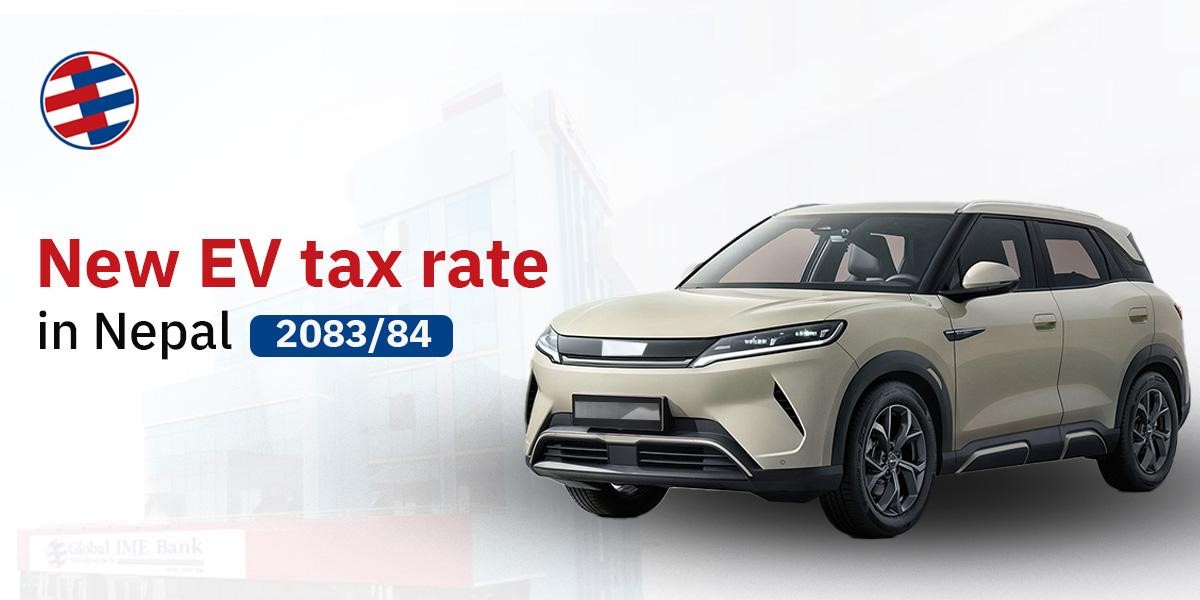
The Budget for FY 2083/84 has introduced significant reforms to the taxation of electric vehicles (EVs) in Nepal. Traditionally, the taxation of EVs was based on the motor power (kW) of the EV, and such system was completely removed and replaced with a price based framework.
Previously, the motor power of EVs was used to determine taxation in the following brackets: 0–50 kW, 51–100 kW, 101–200 kW, 201–300 kW, and over 300 kW. Under the new system, EVs will be taxed based on their CIF value (Cost, Insurance and Freight) at Customs. This new system of taxation shifts the focus from engine power to the value at which vehicles are imported.
In simple terms, Tax of EV will be calculated as:
CIF Value → Customs Duty → Clean Infrastructure Investment Fee → Road Development Fee → VAT → Total Taxable Value
Major Changes of EV Tax Rate in Budget 2083/84
- Stopped motor power-based taxation
- All EV passenger vehicles now have a customs duty of 20%
- Excise Duty removed
- Clean Infrastructure Investment Levy (CIIL) introduced
- Taxes now based on customs value (vehicle price)
What Was the Old EV Tax System?
Prior to Budget 2083/84, motor capacity (kW) was the primary determinant for taxation for EVs.
| Motor Capacity | Customs Duty | Excise Duty | Road Tax | VAT |
| Up to 50 kW | 15% | 5% | 5% | 13% |
| 51–100 kW | 20% | 15% | 5% | 13% |
| 101–200 kW | 30% | 20% | 5% | 13% |
| 201–300 kW | 60% | 35% | 5% | 13% |
| Above 300 kW | 80% | 50% | 5% | 13% |
New EV Tax Slabs After Budget 2083/84
The government has now introduced a uniform customs duty of 20% and replaced excise duty with the Clean Infrastructure Investment Fee(CIIF).
| CIF Vehicle Value | Customs Duty | CIIF | Road Tax | VAT |
| Up to Rs. 20 Lakh | 20% | 2.5% | 5% | 13% |
| Rs. 20–30 Lakh | 20% | 20% | 5% | 13% |
| Rs. 30–40 Lakh | 20% | 35% | 5% | 13% |
| Rs. 40–50 Lakh | 20% | 90% | 5% | 13% |
| Above Rs. 50 Lakh | 20% | 130% | 5% | 13% |
To make it easier, let’s look at a quick example: an EV priced at Rs 20 lakh CIF.
- Customs Duty (20% of CIF) → 20%×20,00,000=4,00,000 → Total = Rs 24,00,000
- Clean Infrastructure Tax (2.5% of CIF + Customs Duty) → 2.5%×24,00,000=60,000 → Total = Rs 24,60,000
- Road Development Fee (5% of previous total) → 5%×24,60,000=1,23,000 → Total = Rs 25,83,000
- VAT (13% of previous total) → 13%×25,83,000=3,35,790 →
- Total Taxable Value = Rs 29,18,790 (~29.19 lakh)
Old vs New EV Tax Slabs: Complete Comparison
| Category | Old System (kW Based) | New System (CIF Value Based) |
| Tax Basis | Motor Capacity (kW) | Vehicle CIF Value |
| Customs Duty | 15%–80% | Flat 20% |
| Excise Duty | 5%–50% | Removed |
| Infrastructure Levy | Not Applicable | 2.5%–130% |
| VAT | 13% | 13% |
| Road Tax | 5% | 5% |
| Luxury Definition | Above 300 kW | Above Rs. 50 Lakh CIF |
| Tax Predictability | Based on Motor Power | Based on Import Value |
What Is the Clean Infrastructure Investment Fee (CIIF)?
The Clean Infrastructure Investment Fee (CIIF) is the new charge introduced on EV imports after Budget 2083/84. It has replaced the old excise duty system for electric vehicles.
The government has introduced this fee to support the development of EV-related infrastructure in Nepal, such as:
- Charging stations
- Battery management systems
- Domestic EV infrastructure
- Cleaner transport ecosystem
- Long-term electric mobility support
Financing Your EV with Global IME Bank
With the new tax system the prices of EVs might increase significantly. However owning one is still within reach thanks to financing options of Global IME Bank. Global IME Bank offers a dedicated Global Auto Loan – Green Drive Scheme. This loan is designed to make an easier purchase of EV vehicles. With competitive interest rates, flexible repayment plans, and quick processing, you can easily buy the dream electric vehicle of your choice without paying the whole amount at the purchase.
Conclusion
The price of the vehicle as it arrives in Nepal will now determine the new tax system. As the CIF value increases, so does tax liability. Therefore, premium, high valued EVs will have a larger tax liability, regardless of the size of the motor.