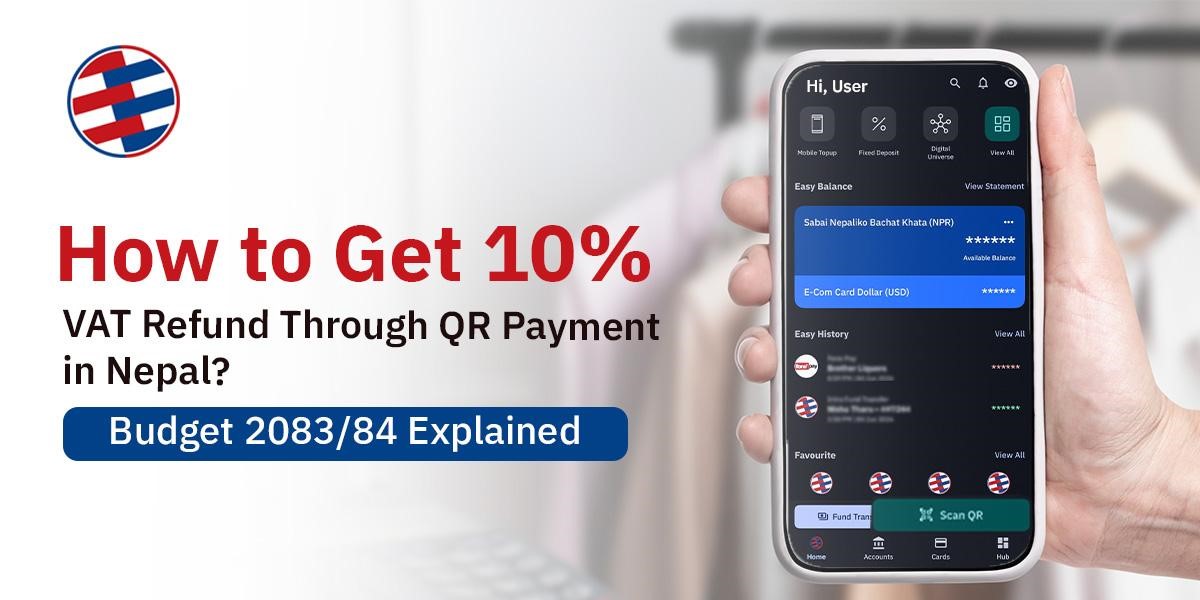
Budget 2083/84 has introduced various consumer benefits when using a digital payment method while shopping. Finance Minister Dr. Swarnim Wagle, announced that consumers paying via QR Code, mobile banking, digital wallets, cards, etc., and collecting official VAT bills will get 10% of the VAT amount automatically refunded.
The purpose of this policy is to promote digital payments, enhance tax accountability, and develop a culture of bill collection in Nepal. For a long time, many people paid cash and ignored bills. Businesses could hide transactions, and the government lost tax revenue, too. The new VAT return system hopes to address that problem and offers an incentive to consumers to pay digitally.
What Is VAT?
VAT (Value Added Tax) is an indirect tax levied on the sale of goods and services in Nepal. The current VAT rate is 13%. Whenever consumers make a purchase of goods or services that are offered by businesses that are registered under the VAT system, they pay the tax.
As an example, if a consumer makes a purchase of a product with a price of Rs. 1,130, the VAT amount paid is Rs 130. Most consumers are already paying VAT daily without their knowledge because it is included in the total price of the purchase.
Many businesses in Nepal fail to issue proper receipts after cash transactions, allowing them to hide actual sales and avoid paying taxes fully. To address this, the government is introducing the digital VAT refund system.
What Is the New VAT Return Policy in Budget 2083/84?
The Government of Nepal announced that consumers who make digital payments and collect official VAT bills will receive 10% of the VAT amount back automatically.
You will be eligible for automatic VAT refunds if you pay using one of the following and have a valid VAT bill:
- QR payments
- Mobile banking
- Internet banking
- Debit or credit cards
- Digital wallets
The government has also mentioned that invoice monitoring systems will be used.
Why Did the Government Introduce This Policy?
The main objectives are:
- The use of digital payments will be encouraged
- Consumers will be encouraged to request bills
- There will be a reduction in the evasion of taxes
- There will be an improvement in the transparency of business transactions
- The digital economy of Nepal will be further developed
This policy goes beyond just providing cash back to consumers, as it contributes to the greater goal of modernizing tax collection and providing a more transparent economy.
How to Get 10% VAT Refund Through QR Payments?
This system has been designed to be user-friendly and to operate in an automated manner. To receive the VAT refund, simply pay using a digital method and request a VAT bill.
Step-by-Step Process
- Buy goods or services from a business.
- Pay digitally using QR code, mobile banking, wallet, or card.
- Collect the official VAT bill.
- The transaction gets recorded in the government’s electronic billing system.
- 10% of the VAT amount gets refunded automatically.
The refund may later be credited directly to the consumer’s linked bank account or digital wallet, although the government has yet to release detailed operational guidelines.
How Much VAT Refund Will You Actually Get?
Many people think that the announcement means that 10% of the total amount spent on shopping will be refunded. This is incorrect. The refund will only be 10% of the VAT amount, not 10% of the total purchase cost.
Example Calculation
| Shopping Amount | Approx. VAT | 10% VAT Refund |
| Rs. 1,000 | Rs. 115 | Rs. 11.50 |
| Rs. 5,000 | Rs. 575 | Rs. 57.50 |
| Rs. 10,000 | Rs. 1,150 | Rs. 115 |
The amount of the refund may seem small, but to families and frequent shoppers who make digital transactions daily, the value can be substantial. The main goal of this program is to change people’s behavior. The government expects that people will start to prefer digital payments and will demand bills.
What Is the Bill Lottery System?
The other significant announcement of Budget 2083/84 is the creation of a Bill Lottery System. Consumers who have collected official VAT bills will be eligible for a reward program based on a lottery and prize system. To create a culture of bill collection, the government will be using incentives rather than only penalties and audits.
Significance of the Policy
The bill lottery system helps in:
- Motivate consumers to demand bills
- Decrease false or unreported transactions
- Promote tax payment
- Drive business transparency
Taiwan has successfully implemented invoice lottery systems to boost tax collection and digital billing. Nepal seems to adopt a similar model.
What Does This Policy Mean for Businesses?
Businesses with an annual turnover greater than Rs. 10 Crore now have to register with Central E-Billing and the Invoice Monitoring System. This means that those businesses have to:
- Create digital invoices
- Keep records of electronic transactions
- Bill transparently
- Report transactions accurately
This can make the market more equitable for businesses that operate legitimately. Many businesses are still stuck sustaining unfair competition from businesses that hide transactions and do not pay taxes.
In the long run, digital billing systems can make internal business systems easier and help with the efficiency of accounting and auditing.
Why Should Consumers Always Ask for Bills?
Asking for bills is no longer about consumers keeping receipts. Bills are now a potential consumer benefit under the new policy.
Benefits of Taking Bills
- Make a claim for a VAT refund
- Participate in a bill lottery
- Have proof of purchase to claim a warranty
- Bills now play a role in a consumer strengthening a transparent economy
If consumers begin to demand bills from businesses, it will be more difficult for businesses to hide transactions. This will positively impact tax collection, and the government will be able to provide greater services and improve infrastructure.
Challenges of the New VAT Refund System
The new VAT Refund system, though optimistic, may become difficult to manage with the digital and electronic billing system infrastructure disconnect in Nepal.
Potential Problems
- Lack of a digital billing system in small businesses
- Fraudulent Transactions
- Low public knowledge of how VAT works
- Time for technological integration.
Managing and building the digital billing system leaves the rest of the challenges to the government. This announcement is one of the major digital reforms of payment and taxation of recent years.
Conclusion
The VAT Refund policy of the Budget 2083/84 could modernize shopping and payment systems in Nepal. Enhancing transactional and billing system transparency, consumers paying digitally and collect VAT bills will receive an automatic VAT Refund.
The obvious intent of the government: bolstering a digital economy, and limiting tax evasion with a VAT Refund and an increased digital payment system.
During your next shopping experience, electronically pay, collect your receipt, and enjoy VAT Refund benefits.
FAQs
1. What is the prevailing VAT in Nepal?
VAT on goods and services in Nepal is 13%.
2. Do consumers receive a refund of 10% of the total shopping amount?
No. Consumers receive 10% of the VAT.
3. Which payment methods are eligible for VAT Refund?
VAT Refund may be received for QR payment, mobile and internet banking, debit cards, and digital wallets.
4. Will cash payments be eligible for VAT Refund?
No, cash payments will not be eligible since the system is primarily designed for digital payments.
5. Is the VAT refund procedure automated?
Yes. The government envisions implementing an automated VAT refund scheme integrated with electronic billing systems.